Policy and reports
In this section of the website, policy documents issued by BBIA and others can be found alongside the many reports and studies issued by third parties that we believe are relevant to the bioeconomy.

Air quality-related health damages of food
Agriculture is a major contributor to air pollution, the largest environmental risk factor for mortality in the United States and worldwide. It is largely unknown, however, how individual foods or entire diets affect human health via poor air quality.
This report from the Proceedings of the National Academy of Sciences (PNAS) explores how food production negatively impacts human health by increasing atmospheric fine particulate matter.

Biodegradation of synthetic polymers in soils: Tracking carbon into CO2 and microbial biomass
Plastic materials are widely used in agricultural applications to achieve food security for the growing world population. The use of biodegradable instead of non-biodegradable polymers in single-use agricultural applications, including plastic mulching, promises to reduce plastic accumulation in the environment. This report by researchers at ETH Zurich and Eawag have now identified an alternative: films made of the polymer PBAT biodegrade in soils.


An environmental and economic assessment of bioplastic from urban biowaste
This study quantifies the environmental and economic consequences of diverting municipal food waste and wastewater sewage sludge from traditional management to the biorefinery-based production of polyhydroxyalkanoates (PHA) in five geographical regions.

Widespread occurrence of pesticides in organically managed agricultural soils: the ghost of a conventional agricultural past?
Pesticides are applied in large quantities to agroecosystems worldwide. To date, few studies assessed the occurrence of pesticides in organically managed agricultural soils, and it is unresolved whether these pesticide residues affect soil life. This comprehensive study demonstrates that pesticides are a hidden reality in agricultural soils, and our results suggest that they have harmful effects on beneficial soil life.


DEFRA statistics on waste managed by local authorities in England in 2019/20
This release relates to the collection and management of waste under the possession or control of local authorities in England. It covers three principal measures:’waste from households’, local authority collected waste and household waste. This release was delayed due to reporting difficulties experienced by some local authorities during the Covid-19 epidemic in 2020.

The economics of biodiversity: the Dasgupta review
The Dasgupta review is an independent report into the relationship between nature and economics, written by Professor Partha Dasgupta. The review demonstrates that in order to judge whether the path of economic development we choose to follow is sustainable, nations need to adopt a system of economic accounts that records an inclusive measure of their wealth.

Innovative feedstocks in biodegradable bio-based plastics: a literature review
Within the framework of Bioplastics Europe and the EU Horizon 2020 programme, the Hamburg Institute of International Economics reviews recent results of the literature on Environmental Life Cycle Assessment (ELCA) regarding the ecological impacts of alternative and innovative feedstocks for the production of bio-based and biodegradable polymers.

Dynamic material flow analysis of PET, PE, and PP flows in Europe: Evaluation of the potential for circular economy
This American Chemistry Society publication evaluates the potential circularity of PET, PE, and PP flows in Europe based on dynamic material flow analysis (MFA), considering product lifetimes, demand growth rates, and quality reductions of recycled plastic (downcycling).

Review of recent advances in the biodegradability of polyhydroxyalkanoate (PHA) bioplastics and their composites
This review from the Royal Society of Chemistry summarises recent advances and opportunities to utilise polyhydroxyalkanoates (PHAs) as a biodegradable substitute in some applications where non-biodegradable and petroleum-based plastics are currently used.
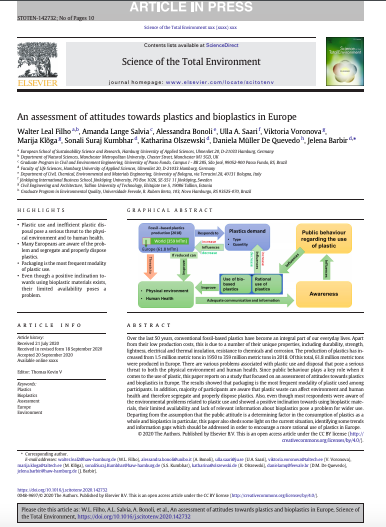
An assessment of attitudes towards plastics and bioplastics in Europe
Departing from the assumption that the public attitude is a determining factor in the consumption of plastics as a whole and bioplastics in particular, this paper sheds some light on the current situation, identifying some trends and information gaps which should be addressed in order to encourage a more rational use of plastics in Europe.