Policy and reports
In this section of the website, policy documents issued by BBIA and others can be found alongside the many reports and studies issued by third parties that we believe are relevant to the bioeconomy.
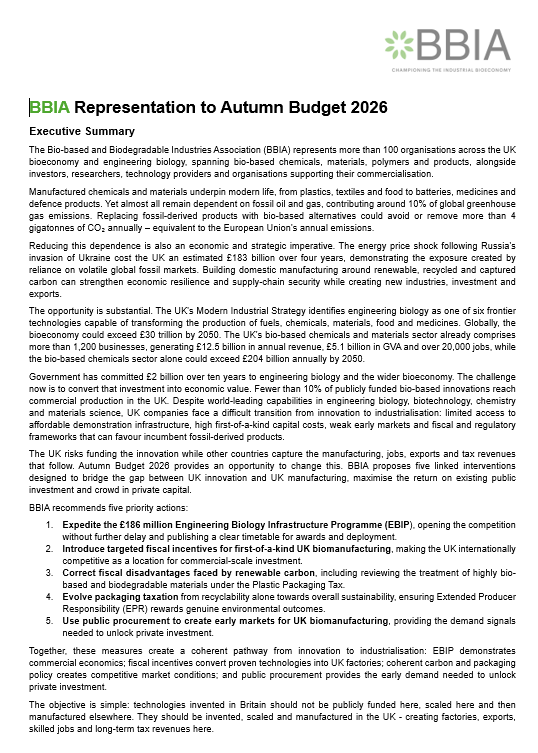
BBIA Representation to Autumn Budget 2026
The UK does not lack bioeconomy innovation. The challenge is turning that innovation into manufacturing, investment and jobs here in the UK. Ahead of the Autumn Budget 2026, BBIA is calling on Government to take five practical steps to help bridge the gap between world-leading UK science and industrial-scale manufacturing.
Biotech Act II (EU): Addressing cross-cutting challenges and establishing an enabling regulatory framework for industrial biotechnology and biomanufacturing
Biotech Act II (EU): Addressing cross-cutting challenges and establishing an enabling regulatory framework for industrial biotechnology and biomanufacturing

Bio-Beauty: The Future of Engineering Biology in UK Cosmetics
The UK’s Modern Industrial Strategy aims to position the country as a global leader in technology-driven innovation by 2035, with engineering biology identified as a key growth sector capable of transforming industries such as beauty and personal care through sustainable, bio-based production. While the UK is well placed to lead this transition, regulatory complexity, high costs, and limited domestic supply chains are slowing progress. This report highlights the challenges and opportunities that lie ahead, and five priority actions are recommended.

UK Fermentation & Downstream Processing Capacity: Current Capability, Scale-Up Gaps and Investment Needs for Engineering Biology in Non-Human Health Applications
The UK is at a critical point in developing its engineering biology sector, with advances creating new opportunities across multiple industries. Yet a common claim persists: that limited scale-up infrastructure is the main barrier to market. This report challenges that view. Drawing on industry insights and survey data, it finds that while fermentation and downstream capacity matter, the real barriers to commercialisation are broader—spanning investment, coordination, and the link from research to industry.

Rethinking UK Packaging Policy to Unlock Bio-Based Innovation, National Resilience and Economic Growth
Modern society depends on packaging to store, protect, and transport goods at scale, supporting essential systems such as food supply, healthcare, and e-commerce, while reducing damage, contamination, and waste. However, most packaging remains fossil-based and short-lived, generating significant waste and emissions; with the UK producing around 12 million tonnes annually and recycling rates still limited, policy misalignment and higher costs for bio-based alternatives risk slowing innovation, investment, and the transition to a more sustainable circular economy.
BBIA Annual Report 2025
2025 has been a defining year for BBIA and for the UK’s modern industrial bioeconomy. As global momentum for bio-based solutions accelerates, BBIA’s role as a convenor, evidence-builder, and trusted voice has become more important than ever.
This Annual Report sets out how BBIA has delivered against its four core pillars – Influence, Innovate, Connect, and Communicate – during 2025, and the foundations laid for 2026 and beyond as we work towards a resilient, sustainable, and globally competitive UK bioeconomy.
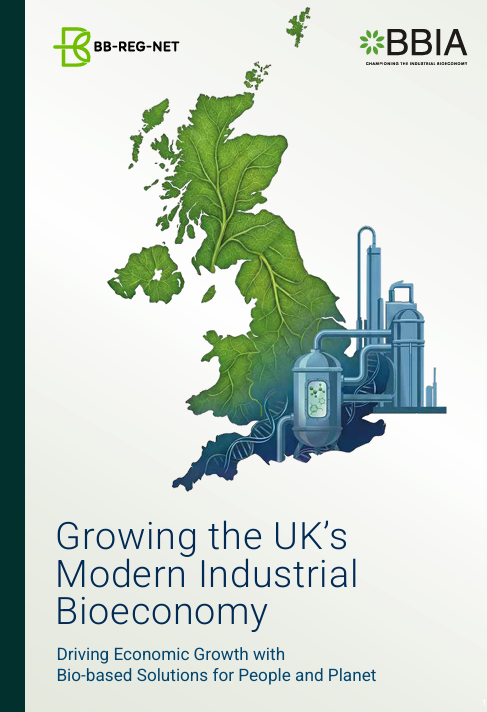


Unlocking Regulatory Pathways for Novel Bio-Based Chemicals and Materials in the UK
The UK’s Modern Industrial Strategy aims to position the nation as a global leader in technology-driven innovation by 2035, with Engineering Biology at its core, representing a £30 trillion global bioeconomy opportunity. However, this report highlights that outdated and fragmented regulations are stifling bio-based innovation, costing SMEs millions in lost value and jobs, and risking the UK’s competitiveness unless a clear, proportionate, and science-led regulatory framework is established.

Simpler Recycling: HIDDEN IMPACTS FOR CIRCULAR PLASTICS SYSTEMS
As England prepares for the rollout of Simpler Recycling, the University of Birmingham Plastics Network, in consultation with experts from RECOUP, the UK’s leading independent authority and trusted voice on plastics resource efficiency and recycling, and the Bio-based and Biodegradable Industries Association (BBIA), has conducted an analysis of the challenges that the implementation of simpler recycling will have on plastics circularity. Simpler Recycling (SR) aims to help meet the UK Government’s target of 65% recycling by 2035.